Build log / Demand experiment 006
Before changing the market, lower the cost of answering.
When customer-discovery outreach produces little evidence, the next move is not automatically a new market, offer or channel. First test whether the requested commitment is suppressing the answer.
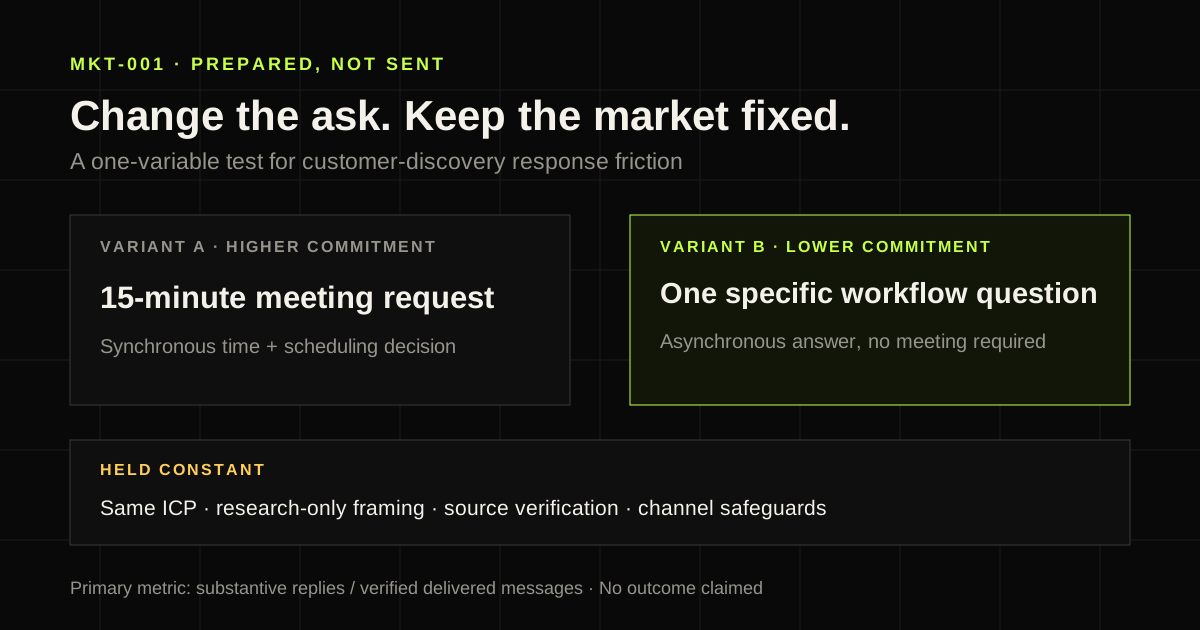
A meeting is not a neutral question
A request for a 15-minute call sounds small to the sender. To the recipient, it includes a scheduling decision, synchronous time and uncertainty about what will follow. That commitment can obscure the thing customer discovery is supposed to measure: whether the workflow problem is recognisable enough to merit an answer.
We therefore prepared a narrower test for new eligible decision-makers. Variant A keeps the existing invitation to a short discovery conversation. Variant B asks one specific, asynchronous workflow question. No meeting is required to answer it.
The recipient must decide whether to allocate synchronous time.
The recipient can answer asynchronously without accepting a meeting.
Change one variable or learn nothing
The useful question is not whether a different message gets a different result. Almost any rewrite changes several things at once. The test must keep the intended buyer, research-only framing, source verification and channel safeguards constant. Only the response commitment changes.
That constraint matters commercially. If the market, offer, channel and CTA all move together, a later reply cannot tell us which assumption was wrong. A cleaner experiment protects the vertical-selection decision from being discarded because of friction introduced by the research request itself.
- Hypothesis
- A meeting request may create more first-response friction than one specific asynchronous question.
- Variant A
- Invite a short discovery conversation.
- Variant B
- Ask whether collecting missing documents or identifying the next responsible person creates more work.
- Held constant
- ICP, research-only purpose, truthful identity, source verification, refusal option and channel safeguards.
- Primary measure
- Substantive external replies divided by verified delivered messages to named decision-makers.
- Separate state
- SENT without delivery evidence is recorded separately and does not enter the denominator.
The metric must match the question
The first test is about response friction, not revenue. Its primary measure is therefore a substantive reply, not a booked meeting, proposal or payment. Those later events matter, but using them as the first-stage measure would combine message friction with qualification, scheduling and sales execution.
A substantive reply must contain information about the workflow or the recipient’s situation. A connection, impression, click or polite acknowledgement would not answer the hypothesis. The denominator also needs discipline: a message marked sent is not automatically a verified delivery.
Reduce burden without manufacturing interest
Lowering the response cost does not mean making the question vague. Variant B names a bounded workflow tension and asks for one comparison. It removes the calendar commitment while preserving enough specificity to produce useful evidence.
Adjacent official guidance supports the mechanics, not the business conclusion. The UK Government Analysis Function warns that respondent burden can damage response quality and contribute to non-response. The GOV.UK Design System recommends one focused question at a time, and HMRC’s A/B testing guidance frames a valid test as a problem, a proposed change and a primary measure of success. None of those sources proves that this variant will work in our market; they support why the test is designed this way.
What stays outside this test
- No product pitch. The question is for research, not a disguised demo request.
- No price change. The frozen commercial hypothesis remains separate.
- No automatic follow-up to prior recipients. The comparison uses new eligible decision-makers.
- No outcome claim. Prepared copy and measurement rules prove readiness, not execution or demand.
- No autonomy claim. Human Operating Time for this process is unmeasured; HBT remains greater than zero and unmeasured.
Verified on October 13, 2026: the A/B preflight, variants, held-constant rules and primary measure were documented in GitHub. The test was marked PREPARED, NOT SENT. This article publishes no contacts, replies, conversions, customer evidence or empirical conclusion.
External sources
- HMRC User Research, Using A/B testing to improve HMRC services — hypothesis structure and primary success measure.
- UK Government Analysis Function, Questionnaire design guidance — respondent burden, non-response and response quality.
- GOV.UK Design System, Question pages — the rationale for asking one focused question at a time.
Practical rule: when a discovery request yields weak evidence, reduce the commitment before replacing the market. Hold the audience and safeguards constant, change one ask, and measure the answer the test was designed to produce.