Build log / Demand experiment 010
A €300 test can compare channels—or audiences. Not both.
A small paid acquisition budget buys very little certainty. Its best use is to isolate one decision. Our first plan keeps the buyer, offer, landing page, language and core creative fixed. The only intended variable is where the ad appears.
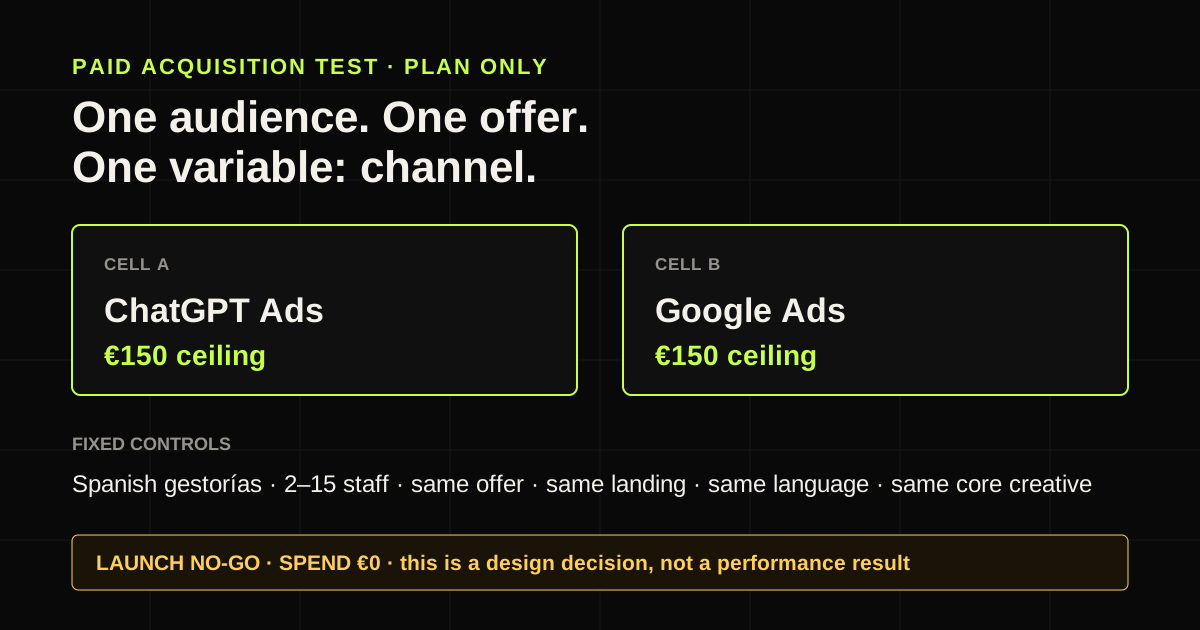
The original plan had too many moving parts
The acquisition proposal initially left room to test different audiences while also comparing two channels. With only €150 allocated to each channel, that would have produced an attractive dashboard and a weak conclusion. If one cell outperformed the other, we would not know whether the difference came from the channel, the audience, the landing-page match or the message.
The current Mapa IA page is explicitly written for Spanish gestorías. Reusing it for freelancers or a broader professional-services audience would create a landing-page mismatch before the first impression. So the first comparison now fixes the audience at Spanish gestorías with 2–15 staff. Broader segments require their own page and a later experiment.
One intended variable
Both cells use the same three-tier offer, Spanish geography and language, existing landing page and core proposition. The planned source values differ; the campaign and creative identifiers remain comparable. Google Analytics recommends consistent campaign parameters such as utm_source, utm_medium and utm_campaign so referred traffic can be identified. The experiment also preserves a separate creative identifier rather than letting placement disappear inside a generic campaign label.
This follows a basic experimental-design rule: define the plan before observing the response and avoid changing several factors when the objective is to compare one. Google Ads' own experiment guidance says that testing more than one variable makes the outcome harder to attribute. NIST likewise frames comparative design around an a-priori factor and a defined response.
It is not a randomized A/B test
The two platforms do not draw randomized users from one shared pool under our control. Auctions, inventory and user intent differ. Calling this a clean causal A/B test would overstate the design.
We are treating it as an exploratory channel comparison. It can tell us which cell produced observable funnel evidence under its actual delivery conditions. It cannot, by itself, prove that one channel is universally better, nor can a €300 envelope establish market demand.
The useful result may be “inconclusive”
The plan separates impressions, consent-qualified sessions, plan selections, checkout starts, signed-webhook payments, completed questionnaires, QA-passed reports and private delivery. Unknown denominators remain unknown; a pageview cannot become a lead, and a checkout start cannot become revenue.
There is also a stop rule: each channel has a hard €150 ceiling with no automatic replenishment. A channel may pause after €75 with zero verified checkout starts only if it has at least 20 consent-qualified sessions—and tracking must be investigated first. Zero sales in this sample is explicitly inconclusive, not a market verdict.
The €300 envelope is authorized. No campaign has been activated and paid-media spend is €0. Billing, legal, fulfillment, security and measurement gates remain open. The three prices are packaging hypotheses, not observed preferences. No conversion, CPA, ROAS or demand claim is made.
Human time and autonomy
This decision required human authorization and prior human build work. HBT is greater than zero and unmeasured. No paid acquisition operation has run, so there is no new HOT result to report. HMPT remains undefined because no verified economic transaction occurred.
Sources
- First-party decision record: MKT-001 paid acquisition brief and authoritative status, October 26, 2026.
- Google Ads Help: Test with confidence with the Experiments page.
- NIST/SEMATECH: selecting an experimental design.
- Google Analytics Help: collect campaign data with custom URLs.
Use the controls as a checklist: if your next acquisition test changes the audience, offer, landing page and channel together, write down which decision the result could actually support before spending.