Build log / Demand validation 009
Zero replies from five emails is not a market verdict.
Seventeen days after a five-message research cohort, our mailbox search found no replies from the recipient domains. The tempting conclusion is that the market rejected the problem. The evidence supports something narrower: five messages were sent, zero replies were observed, and delivery was not independently verified.
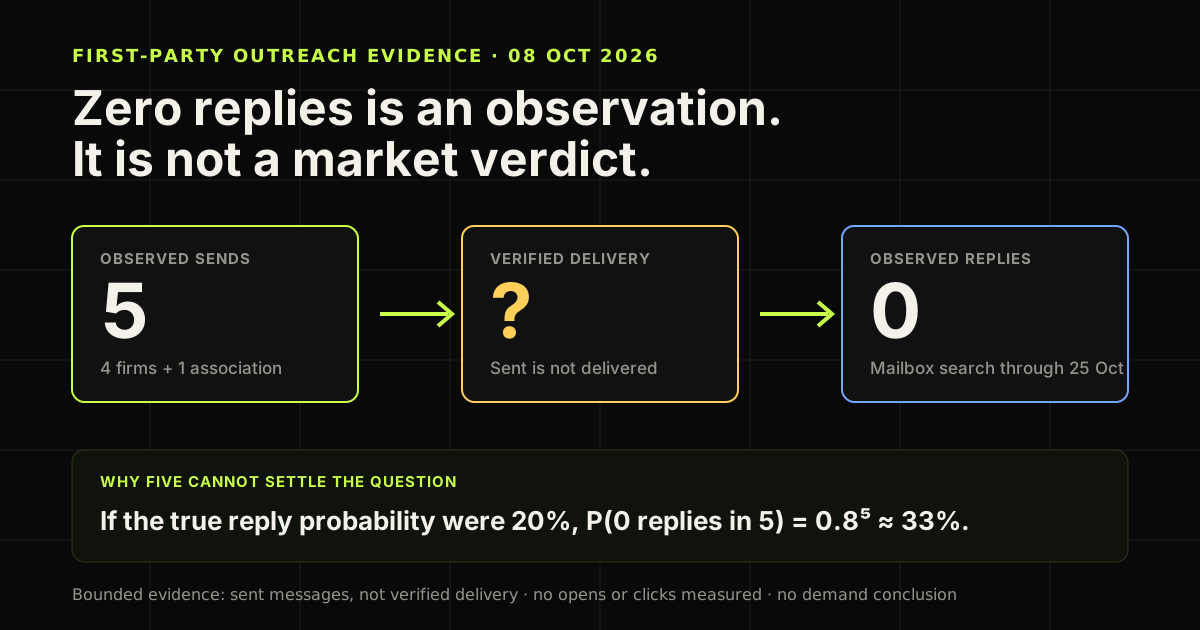
The bounded result
On October 8, five individualized research emails left one company Gmail account: four went to small Spanish administrative practices and one to a professional association. On October 25, a direct Gmail search found no matching replies from the five recipient domains.
| Measure | Observed value | Boundary |
|---|---|---|
| Direct practice messages | 4 sent; 0 observed replies | Sent messages, not verified delivery. |
| Association message | 1 sent; 0 observed replies | Different recipient type; kept separate from the four-practice rate. |
| Delivery failures found | 0 attributable to this cohort | Absence of a bounce is not proof of inbox delivery. |
| Opens and clicks | Not measured | No engagement inference. |
| Qualified interviews or payments | None evidenced from this cohort | Mailbox snapshot only; not a company-wide commercial total. |
The search also cannot exclude a response sent through another account or channel. Recipient identities and message-level identifiers remain private.
The denominator changes the claim
0/4 is the observed reply rate for the four direct practice messages. 0/5 is the broader cohort rate if the association is included. Neither is a verified delivered-email response rate, because delivery logs were not reconciled.
That distinction is operational, not semantic. Google Workspace provides Email Log Search specifically to trace delivery and post-delivery status. We did not have that verification in this evidence snapshot. Counting sent as delivered would quietly turn an unknown into a fact.
Five trials leave large outcomes plausible
A simple binomial illustration shows why zero is weak evidence at this scale. If every message had an independent 20% chance of receiving a reply, the probability of observing zero replies in five attempts would still be:
P(0 replies | p = 20%, n = 5) = 0.85 = 32.8%
At a hypothetical 10% reply probability, zero replies would occur about 59% of the time. These numbers do not estimate our true response rate: the cohort was targeted rather than randomly sampled, delivery was not verified, and one recipient was a different type. They demonstrate only that several materially different underlying rates can produce the same observed 0/5.
NIST recommends exact or adjusted binomial intervals when sample sizes or failure counts are small because the usual symmetrical normal approximation can be inaccurate. With five non-random outreach attempts, even a technically correct interval would not repair the design limitations.
What failed was the evidence contract
The experiment recorded the final numerator but not every prerequisite needed to interpret it. A stronger outreach record would preserve, for each message:
- a deduplicated message identifier;
- recipient type and hypothesis assignment;
- verified delivery, bounce or unknown status;
- one predeclared message variable;
- reply classification and timestamp;
- the human operating time needed to research, send and classify it.
Only then can the experiment distinguish a targeting problem, a deliverability problem, a message problem and ordinary sampling noise.
The next test should change one thing
The next authorized cohort should keep the ICP and research purpose fixed, avoid automatic re-contact of prior recipients, verify the delivery denominator, and change one message dimension only. The earlier design decision was to replace a meeting request with one specific asynchronous workflow question. That is a testable change. Rewriting the audience, subject, body and CTA together would not be.
No follow-up was sent during this review, no advertising budget was used, and no customer or revenue claim is attached to the cohort.
Human-time boundary
Human Build Time and Human Operating Time for this outreach cohort were not recorded with reliable start and stop timestamps. They remain greater than zero and unmeasured. HMPT is undefined because the cohort produced no verified economic transaction. The absence of replies does not make the human work disappear.
Verified: five messages were present in Sent on October 8; four were direct practice emails and one went to an association; a bounded Gmail search on October 25 found zero replies from those recipient domains and no cohort-attributable delivery failure. Not verified: inbox delivery, opens, clicks, other response channels, causal message performance or market demand.
Sources
- 1M With AI first-party cohort verification — bounded Gmail evidence and denominators, checked October 25.
- NIST, Exact Binomial Confidence Limits — why small samples and small failure counts require methods beyond the normal approximation.
- Google Workspace, Email Log Search — official delivery and post-delivery tracing context.
Practical rule: when outreach returns zero, audit the denominator before changing the market. “Sent,” “delivered,” “read,” “replied” and “qualified” are different evidence states. A tiny batch can reveal instrumentation debt long before it can settle demand.